From the first three sections you will get a basic understanding of starter solenoids. We also condensed the information into a buyer checklist for you in the fourth section.

Plastic vs. Aluminum Oil Filter Housings: Key Differences
Plastic and aluminum oil filter housings both fail when production control is wrong. Choose by return data, not perception alone: confirm material grade, critical dimensions, leak-test method, heat-cycle validation and batch traceability before ordering.

What Is an Oil Filter Housing and Why Quality Matters
If you’re looking for an oil filter housing, you need to understand it thoroughly before making a choice. Let’s break down its main functions, core components, and what quality-related factors matter so you can select a precise and functional product.

Meet Sintly at Automechanika Shanghai 2025
Meet Sintly at Booth 4.1H96 during Automechanika Shanghai 2025, November 26-29. Explore our starter solenoids, relays, and other automotive electrical parts.
Are you new to starter solenoids and feeling confused about sourcing good quality starter solenoids? Have you thought about if the solenoids you got are overpriced for their quality? Have you thought about if your supplier may not be so reliable for consistently manufacturing high-quality starter solenoids? Whether you are new to the field, or have been in this field for a while, reading this guide and learning more about starter solenoids can prevent you from being tricked. This guide aims to guide you to become an expert buyer in this field. After reading this, you will also become an expert in inspecting a starter solenoid factory and even be able to test and replace a starter solenoid by yourself.
From the first three sections you will get a basic understanding of starter solenoids. We also condensed the information into a buyer checklist for you in the fourth section. Then, we will move on to the hands-on section for you to learn how to test the starter solenoid with a multimeter. Let's start from the easiest part.
What is a Starter Solenoid
A starter solenoid (also called starter solenoid switch, and solenoid switch) is a small but essential electrical component that connects the battery to the starter motor. It's a powerful eletromagnetic switch which commonly only in a hand full volume. The starter cannot start without it, and the engine won't start if the starter doesn't.
In some regions, starter solenoids are also called starter relays. However, starter relays are often considered another type of product, especially in Asia.
Why does the starter need a starter solenoid as we already have an ignition switch? Why bother to have another switch?
Because cranking the flywheel of the engine to start the car needs a lot of power, the starter needs a larger switch to handle the current. When the starter solenoid receives sufficient power from the battery, it causes the starter motor to crank and operate. If you find the starter, you will find the solenoid.
Thus, getting a high quality starter solenoid is vital, a malfunctioning starter solenoid is one of the common starting issue which we will talk about later. No one wants the car to be stuck in the middle of the road or in front of a green traffic light because of starting issue. As a buyer, make sure to find a good source.
Basic Parts
A typical starter solenoid includes the following parts:
The Terminals
A starter solenoid usually have 3-4 contacts. Two large ones and two small ones.
One of the large bolts are for connecting to the positive terminal of the battery. The other one is to send this current which it got from the battery to the starter.
The small contacts are used for connecting to the ignition coil and the ignition switch.
The main goal of a starter solenoid is to move its plunger to crank the starter, and once this step is done, the plunger needs to return and stay still until the next time the ignition switch is turned on.
When the starter motor is just powered on, the solenoid switch is energized, it creates a magnetic field pushing the starter gear forward to mesh with the flywheel ring gear. The starter gear is sleeved on the starter shaft, and there are spiral threads on it that are opposite to the rotation direction of the starter. When the starter motor is under load (that is, when it drives the engine to rotate), the gear will not retract automatically. Therefore, the solenoid switch will be de-energized after it has pushed the starter gear out during the starting process.
After the engine is started, the starter gear will keep rotating, and due to the spiral threads on the starter shaft, which result in an interaction force between the threads, the starter gear will be pushed back to its original position.
These are some common issues that a car will face if the starter solenoid is malfunctioning.
From this section, you will know the common troubles that a low-quality starter solenoid would have, thus understand and infer what we should look for and avoid when purchasing starter solenoids. These contents are also concluded in the fourth section in a convenient quality-check to-do list for buyers and sourcers.
For your ease of understanding, we categorized these starter solenoid issues by the symptoms of a car. There are three main symptoms when a starter solenoid is malfunctioning:
For example, intermittent starting of the vehicle or no start at all. There can be many reasons.
The issues of contacts:
Corrosion: the terminals of the starter solenoid that usually connect with the wires may corrode due to long-term usage and environmental issues such as humidity. The corrosion will impact the current flow and cause less current goes past the contacts. The starter will either turn slowly or can not be initiated.
Loose connection: the wire connecting the terminals may either be loose or broken, which can stop the current from transferring to the solenoid. It will also be very dangerous if the insulation is broken, as it may release the electricity or cause short circuits.
The issues of the coils:
Coils burn out: the two coils in the solenoid will burn out when they receive too much electricity or are overheated, or are overloaded by a large current flow. When they are broken, they will not be able to pass enough current to the starter, thus the starter will not be able to initiate when you turn the key.
Short circuit: the burned coils can cause short circuit. When the coils are burned, the internal structure will be damaged. The insulation may be damaged, it will cause the wires to connect to each other and create short circuits. This will further prevent the whole electrical circuit from functioning normally.
Open circuit: broken wires or coils cause an open circuit.
Other issues:
Plunger stuck: the plunger will be stuck in one position when dust or other materials get into the solenoid, or if the solenoid is used for a long time. It will further cause the gear to be unable to engage, and it won't allow the electrical current to pass, thus the starter will not be able to start, sometimes you will hear it make noise.
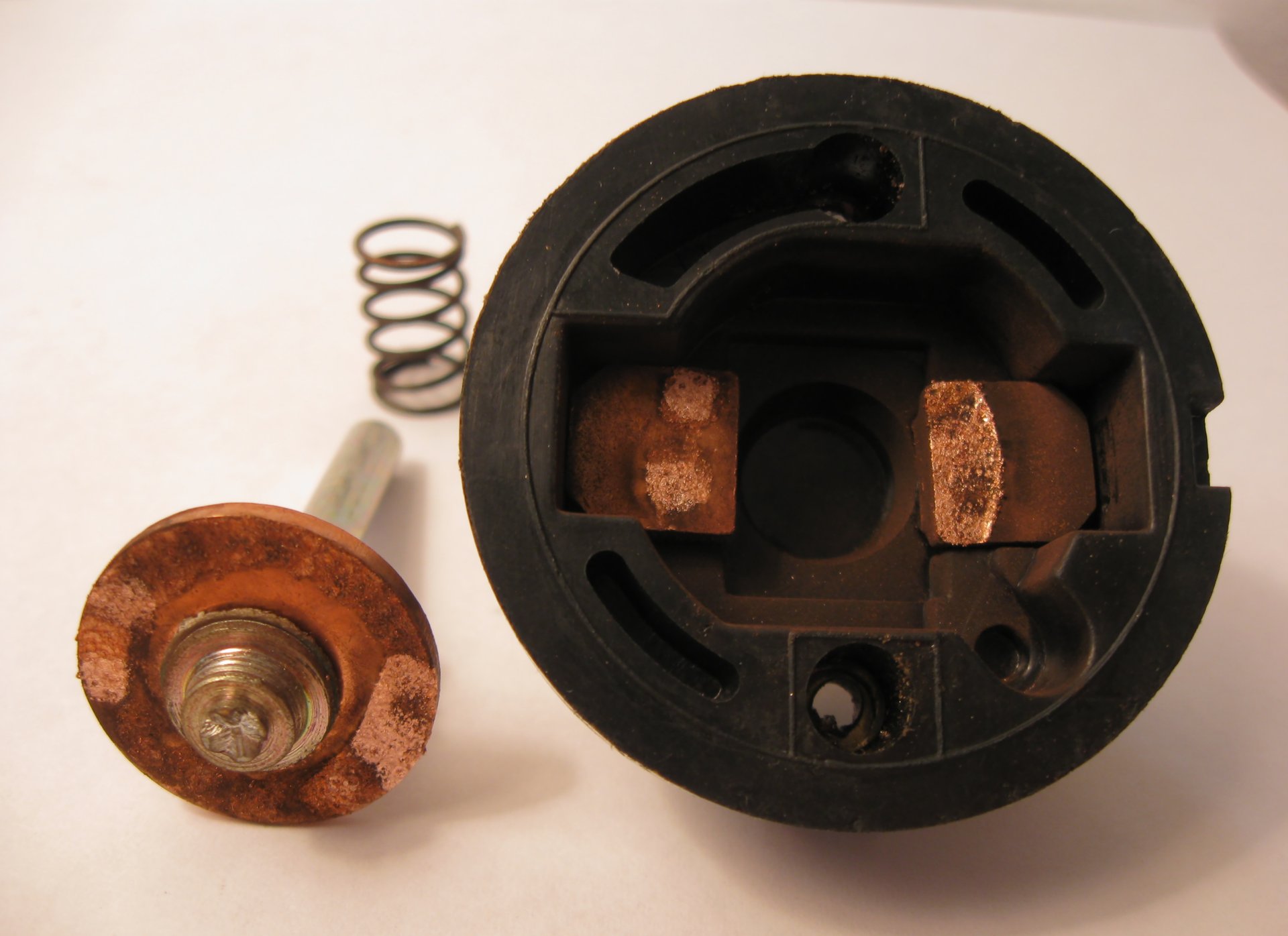
Contacts worn out: the contacts are like two metallic plates, and the current will cause an electrical spark. Thus the contacts will be worn out when they are used for a long time. This will prevent the current from transferring through the contacts, so the starter will not be able to get enough power to start. If the contacts are pitted or black, they are very worn out, and they need to be changed as soon as possible.
Faulty contacts: Just as we mentioned above, contact corrosion and worn-out contacts can cause a malfunction of the solenoid itself. It will make the clicking noise, but as the solenoid is broken, the starter can not start.
A solenoid that stays engaged can drain the car’s battery.
This may be due to damage to the internal structure of the starter solenoid or the circuit, and preventing it from disengaging properly. Ultimately, it leads to continuous power consumption.
Additionally, if the starter solenoid switch remains energized all the time, the starter gear will keep meshing with the engine flywheel regardless of whether the engine has been started or not. In this case, the starter motor will rotate at an excessive speed, or the starter gear will collide with the flywheel gear and get damaged.
Here is a thorough checklist for you to check and test the starter solenoid sample for your reference.
Using a multimeter to test a starter solenoid is the simplest approach which only takes a few minutes. You can spot test the products with a multimeter every time you receive them.
If you have a technician in your team, learning this section can also help you communicate better as a team.
Firstly, we need to understand the electrical circuit of the car starting system, please check the wiring diagram below. The main parts of the starting system are a battery, an ignition switch (also known as a key switch), and a starter. The circuit will be activated by turning the ignition switch.
The connection between the battery and the starter solenoid:
A red wire connects the B+ terminal of the starter solenoid to the positive terminal of the battery to provide electricity to the starter solenoid to crank the starter.
The connection between the ignition switch and the starter solenoid:
A blue wire comes out from the control terminal of the ignition switch. It transfers the control signal from the ignition switch to the S terminal of the starter solenoid, it will result in constructing an electromagnetic field to control the movement of the plunger. Thus it also further controls the starter.
The connection between the starter solenoid and starter:
A green wire connects the M terminal of the starter solenoid to the starter. When the starter solenoid is engaged, the M and the B+ terminal of the starter solenoid are connected. It cranks the flywheel of the engine to spin and starts the engine.
The connection to the ground:
The black wire represents the ground wire. It needs to be connected to the car body at the grounding point, which is also called as "Body Ground". It enables the electricity to return to the negative terminal of the battery and ensures a flawless operation of the electrical system.
Park the car on a safe and solid surface. Don't park it on grass or other soft surfaces.
You can also jack the car up if necessary.
Disconnect the battery for your safety. It will also prevent short circuits. Prepare the tools you need, including a wrench, a screwdriver, wire strippers, and the correct type of wires and terminals for replacement.
Disconnect the wires from the terminals.
Remove the old solenoid.
Connect the positive terminal of the battery to the B+ terminal of the starter solenoid. Tighten the nuts or bolts on the wiring terminals.
Connect the wire to the M terminal of the starter solenoid and the starter. Make sure it is tight.
Use the wire that comes from the ignition switch or the starter relay to connect to the electromagnetic control terminal. This wire is normally very thin because it only needs to transfer the control signal. Make sure you don't scratch anything when you are wiring them.
If the starter solenoid does not have a connection to the ground, you need to use a grounding wire to connect the ground terminal of the starter solenoid to the grounding point on the car frame or the engine.
Make sure the terminals and the grounding point are clean without dust. It is vital for a consistent electrical connection.
After reconnecting all the wirings and the battery, test the new solenoid. Make sure all the terminals are tightly screwed on. Reconnect the negative terminal of the battery, turn on the ignition switch, and start the car.
Check if the starter solenoid and the electrical system are working, and check if the solenoid is functioning properly. If there is any malfunction, turn off the car immediately and check the wirings again to see if there are any short circuits or any other problems.
Preparation
Testing Steps
Make sure the multimeter is in good condition, and use the probes correctly. Connect to the positive terminal with the red probe, and the black probe is used to connect to the negative terminal.
When the starter solenoid is energized, check for continuity. If the multimeter indicates continuity and generates a beep, the contacts are closed properly. If it is not continuous or if the results are inconsistent, the starter solenoid has problems.
The cost of a starter solenoid depends on many factors. The prices range from $10 to $150. The quality of the materials used for the starter solenoid plays a crucial role in its price. Also, normally the heavier the solenoid, the higher the price, as it takes more materials. However, most of the time, the weight of copper of the starter solenoids and its internal design is the most significant factors for its price.
Ultimately, it's always a good idea to check the durability and then evaluate whether it's worth the price.
There are many ways to find suppliers for starter solenoids, and you may also have many suppliers. However, consistently and carefully evaluating your supply chains and suppliers can help you succeed in this competitive market. Having close communication with your supplier and building a healthy business relationship can also help you obtain a more stable supply. It will also help us go further in a long-run.

Starter Solenoid
A starter solenoid that passes a bench test can still fail under real starting conditions. What matters for bulk orders is confirmed specifications, tests under load, samples from production tooling, and batch traceability that can contain a defect.

The biggest automotive aftermarket event in Latin America is back, and Sintly is heading to Mexico City. From July 8-10, our team will be at Booth 1120-1 at Centro Banamex, ready to talk starter solenoids, relays, and aftermarket parts. If you are visitin