A starter solenoid that passes a bench test can still fail under real starting conditions. What matters for bulk orders is confirmed specifications, tests under load, samples from production tooling, and batch traceability that can contain a defect.
The difficulty with a starter solenoid is that many faults remain hidden until the part is fitted to a vehicle. A unit may click as expected on a test bench, show resistance within the stated range and arrive with a clean casing and bright terminals. None of this reveals how it will behave when a cold battery supplies less voltage, the contacts have to carry starter current and the same operation is repeated day after day.
For a distributor, importer or rebuild programme, this is where a low-cost order can become expensive. One failed solenoid may lead to a replacement part, a second workshop visit and a disputed starter motor claim; if the problem spreads across a batch, it can also cost the customer’s confidence in the brand.
The task before a bulk order is therefore not simply to find a starter solenoid supplier with the right catalogue number. It is to establish whether the part will work under real starting conditions — and whether the next 5,000 units will perform like the first five samples.
The range shown in the SINTLY product catalogue illustrates the point: it includes 12V and 24V solenoids for different starter systems, with part numbers carrying very different OE and aftermarket references. They belong to the same product family, but they cannot be ordered against one unchecked set of electrical and fitment assumptions.
A solenoid has two closely timed duties: it moves the starter drive towards the flywheel, then closes the main electrical contacts so that current can reach the starter motor. The sequence takes only a moment, but the margin for error is small.
As battery voltage falls during starting, the pull-in and hold-in coils must still create enough magnetic force to complete the movement. The plunger cannot catch on its way through the housing, and the return spring must release it promptly. At the same time, the contact disc has to meet the main terminals squarely and with enough pressure to carry high current without generating excessive heat.
These parts work as one system, so weakness in one area affects the rest. Coil wire diameter and turn count govern magnetic force and current consumption; contact material and surface flatness influence voltage loss and arcing; and plunger finish, spring force and internal alignment determine whether movement remains clean. Around them, the insulators, seals and housing must withstand vibration, moisture and repeated changes in temperature.
None of these details is easy to judge from an external photograph. Two units sold as the same starter motor solenoid switch may have very different contact materials, winding tolerances or internal finishes. This is why buyers need to look beyond the cross-reference and ask how the design is controlled.
Most warranty reports begin with a short description — no crank, one click, intermittent starting or a starter that remains engaged — which identifies the symptom but rarely the cause.
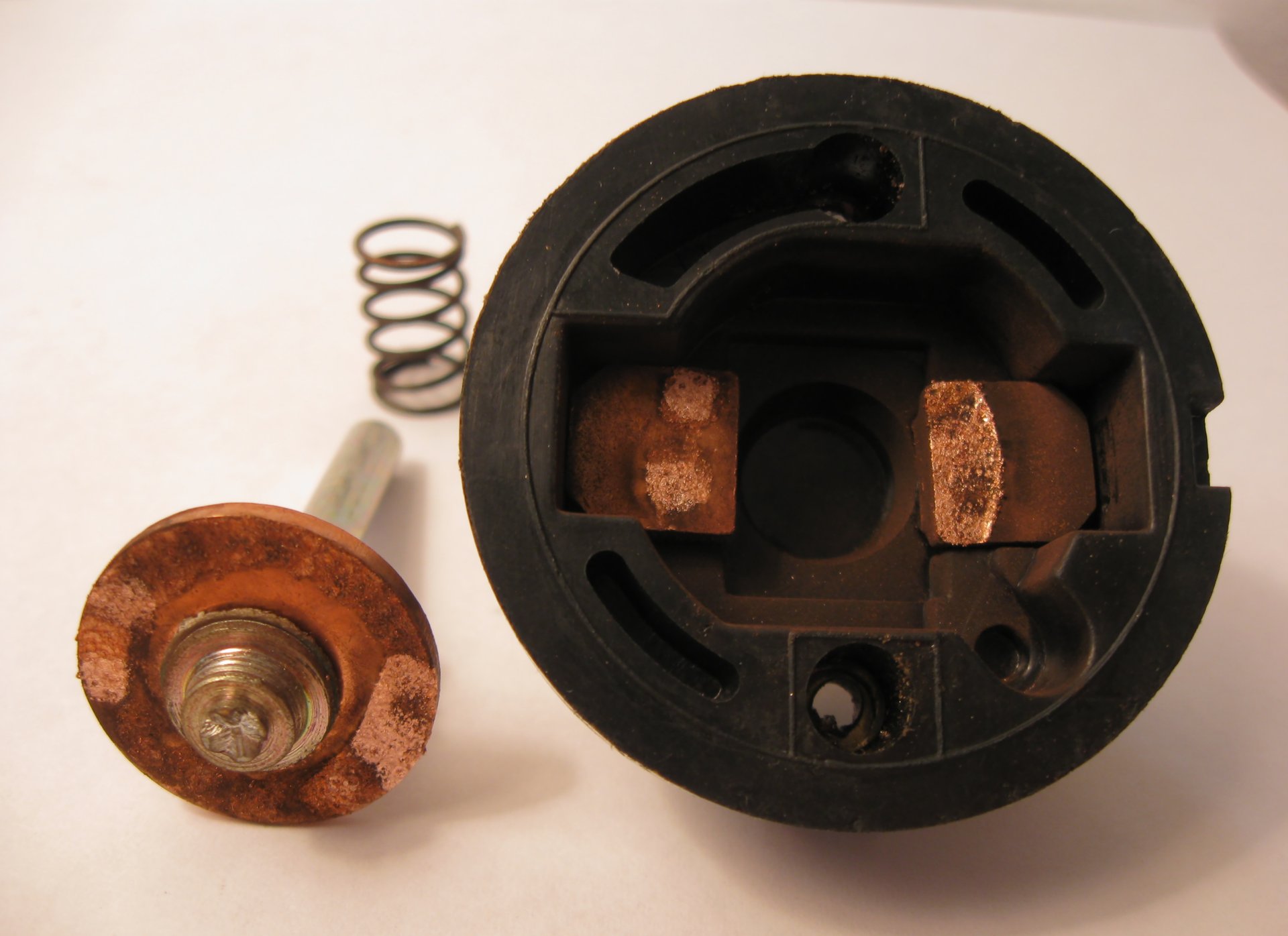
A unit that produces no sound may have an open coil or a broken internal connection, while a solenoid that clicks but fails to crank may be suffering from burned contacts, insufficient plunger travel or excessive resistance in the main circuit. Where the fault is intermittent, contact wear, a loose terminal or corrosion around the plunger may be responsible.
Some failures appear only under particular conditions. An incorrect winding may work with a fully charged battery in a warm workshop, yet fail on a cold morning when less voltage is available. Contacts made from unsuitable material, or closing with too little pressure, may pass an unloaded continuity test and then overheat as soon as the starter motor draws current. A weak return spring creates a different risk: if the switch does not release, or if the contact disc welds closed, the starter can continue running after the key has been released.
Fit is another source of claims. The mounting pattern may be correct while the plunger length, working stroke or terminal angle is not. In that case, the magnetic switch for starter motor applications may fit the housing but fail to move the drive or close the contacts fully.
Not every returned part is defective, because low battery voltage, corroded cables, a damaged ring gear and a failing starter motor can all produce similar symptoms. Even so, the supplier should be able to examine the unit and reach a technical conclusion. A credit note may close the claim. It does not show whether the next batch carries the same risk.
Useful failure analysis begins with the application, installation date, mileage and batch code, before moving on to coil readings, contact condition, terminal security, plunger movement and critical dimensions. SINTLY's guide to how starter solenoids work and why quality matters gives further detail on coil, contact and plunger faults. What matters most is the pattern across several returns: repeated heat damage at one terminal points towards a different cause from corrosion found around the cap on several units.
The phrase “made to OE standard” is common in quotations, but it is not, by itself, a specification.
Before placing an order, the buyer and the starter solenoid manufacturer should agree on the exact OE and starter references, vehicle applications, rated voltage and supply scope. It should be clear whether the quotation covers the solenoid alone or also includes terminal nuts, boots, seals and mounting parts.
The product number should come first. SINTLY lists XL-1757 as a 12V BOSCH-series solenoid with a power entry of 2.8 P, while the same page also provides OE, aftermarket and starter references. A buyer who searches only by appearance, or simply by the words “starter solenoid”, can therefore miss essential identification data before detailed testing even begins.
Catalogue data is the starting point, not the whole acceptance standard. The “P” entry, for example, should remain exactly as shown until the supplier confirms its definition and test basis; the same caution applies to any abbreviated or market-specific parameter. Otherwise, an assumption made during sourcing can quietly become the wrong requirement on an inspection sheet.
The dimensional drawing needs to show more than the outside size, because mounting-hole position, pilot diameter, plunger length, operating stroke, main terminal location, connector orientation and thread details can all affect installation or operation. If one part number is listed for several starter motors, each cross-reference still needs to be checked.
The electrical specification should include pull-in performance, hold-in behaviour, release conditions, current consumption and contact voltage drop. Test temperature and connection points must be stated. Without them, figures from different starter solenoid suppliers may appear comparable when they were obtained in different ways.
This is particularly important for starter solenoid resistance. A starter motor solenoid commonly contains pull-in and hold-in windings. A reading taken between the switch terminal and motor terminal is not the same as one taken between the switch terminal and the housing. Temperature also changes the resistance of copper wire.
A credible specification will therefore identify the terminals used, the reference temperature, the nominal value and the permitted tolerance for each measurement; a figure copied from another part number is not an acceptable substitute.
Materials should be defined where they affect performance. These may include the contact disc and terminal composition, coil wire, terminal plating, cap material, insulation class and corrosion protection. Marking, date codes and packaging requirements should also be settled before production begins. If they are left until final inspection, there is little time to correct them.
No single starter solenoid tester can settle every question of quality. The familiar click confirms that the plunger moved, but says nothing about the force available, the efficiency of the main contacts under current or the way the switch will behave after prolonged use.
The first tests are straightforward: dimensions are checked against the approved drawing, while threads, terminals, plating, seals and markings are inspected for visible variation or damage. The plunger should complete its specified stroke and return without hesitation.
The starter solenoid resistance test can identify an open winding, an incorrect coil or variation in the wire and its connections, provided that the measurement method matches the specification. When the measured values are low, even the resistance of the instrument leads may affect the result, which is why readings should be recorded at a controlled temperature rather than compared without context.
Functional testing then establishes whether the coil can pull in, remain engaged and release under the agreed conditions. The XL-2729, for example, is listed as a 24V HINO-series unit with a power entry of 4.5 P, rather than sharing the 12V rating shown for XL-1757. Even so, testing only at nominal system voltage can conceal a marginal design; the more revealing question is whether the solenoid will still operate at the specified lower voltage, when magnetic force is reduced and mechanical drag becomes more significant.
The main contacts require a loaded test. During a starter solenoid voltage drop test, a defined current passes through the closed contacts while the voltage loss across them is measured. Unless the report states the current, duration, measurement points and acceptance limit, the result is difficult to assess; a continuity reading taken without load certainly does not reveal how the contacts behave at cranking current.
The solenoid should also be observed as part of the complete starter system. SINTLY's article on how to bench test a starter motor covers the battery connection, B and S terminals, voltage, current draw and starter speed, all of which help distinguish a solenoid fault from a problem elsewhere in the starter. Even then, the result must be assessed against the specification for the exact starter model.
Repeated-operation and temperature-rise tests can expose joints that loosen, windings that overheat and contacts that deteriorate quickly. Endurance testing goes further, cycling the starter solenoid switch under a defined electrical and mechanical load. The number of cycles is only meaningful when the energised time, rest period, voltage, load and failure criteria are also known.
Environmental tests depend on where and how the part will be used. Vibration, thermal cycling, humidity, water exposure and corrosion testing may all be relevant. For markets where road salt is common, corrosion around the plunger, terminals and cap joint deserves particular attention. Terminal torque and retention tests are also important because a loose high-current connection can produce heat long before the unit stops working.
Some checks belong on every unit, whereas others require batch sampling or periodic validation. Coil continuity and basic operation are often suited to full inspection, but endurance testing is destructive and is normally carried out on samples. The control plan should make the distinction clear by stating which tests are performed, how often they are performed and what happens when one unit fails.
This distinction is central to starter solenoid quality control. A supplier may have a long test list, but the buyer needs to know which tests were used to approve the design and which ones will actually be applied to the order being shipped.
Samples create false confidence when they are prepared separately from normal production. An approval sample should come from the intended tooling, materials, component sources and assembly line; if technicians selected special parts or adjusted each unit by hand, it says little about what later production will deliver.
The sample submission should include a dimensional report and the actual results from coil, functional and loaded contact tests. Relevant material and plating information should be available, along with endurance or environmental reports for the design. Where a supplier proposes its own equivalent to an OEM starter solenoid, any difference in construction or performance should be declared rather than left for the buyer to discover.
Bench testing is only part of approval. Fitting the solenoid to the intended starter assembly also confirms mounting, terminal clearance, plunger engagement, starter operation and release, while vehicle testing may be required where the application or failure risk justifies it.
Cross-reference data can make this stage look simpler than it is. On the SINTLY product page, XL-1757 is linked to BOSCH OE numbers 0.331.402.013 and 0.331.402.513, Mercedes-Benz 0001523210, aftermarket references including AS-PL SS0007, WAI 66-9123 and ZM-644, and a list of BOSCH starter numbers. These references give the buyer several routes to identify the part, but they do not remove the need to approve the sample against the exact starter included in the order programme.
The same applies to XL-2640. It is listed as a 12V BOSCH-series product and cross-referenced to numbers from AS-PL, BOSCH, Cargo, ERA, WAI/Transpo, Wood Auto and ZM. The page also associates it with heavy-duty industrial and agricultural equipment. For a bulk buyer, that breadth makes starter number and application verification more important, not less.
Once the sample is accepted, one unit should be signed, dated and retained with its drawing revision, test specification and batch details. If a later shipment is disputed, both sides then have something more precise than memory or a catalogue image.
Approval should also set the rules for change. A new contact material, winding source, spring, insulator, plating process or production site may alter performance even when the part looks unchanged. Such changes should be reported before they enter a bulk order.
For the buyer, the central question is not whether a factory can make one good solenoid, but whether it can keep making the same solenoid as volume rises and production continues over several months.
Consistency begins with incoming material, so coil wire, contact materials, springs, terminals, plastic parts and plated components all need defined checks. Production controls must then extend through winding, joining, riveting, terminal assembly and final adjustment. Test equipment and gauges require attention as well: a drifting fixture can approve drifting parts.
Factory capacity can help a buyer judge whether these controls are likely to be sustained, although scale alone is not evidence of quality. According to SINTLY's company profile, the business has produced automotive electrical parts since 1988, operates a 20,000-square-metre factory, and has a 28-person professional team that includes 12 laboratory technicians. For a buyer, the next step is to connect those company-level figures to the product being ordered: which laboratory tests apply to the solenoid, which records are retained, and which line will produce the approved part.
Batch data can reveal change before parts move outside specification. If average starter solenoid coil resistance rises steadily from one lot to the next, or loaded voltage drop begins to approach the limit, the process may already require attention even though every unit still carries a pass stamp. Pass or fail alone hides the movement.
Traceability provides the link between a field problem and the factory record. A code on the solenoid or its packaging should lead back to the production date, line, material lots and inspection results. Product and carton codes need to match. Otherwise, a distributor may be forced to hold all stock when only one production lot is in question.
The simplest way to assess the system is to choose a finished unit and ask the supplier to trace it. A code has practical value if the factory can retrieve the winding material, contact batch, production record and final test data; if it leads only to a month of manufacture, it may not be enough to contain a defect.
A tested part can still arrive damaged. The main terminals are vulnerable to impact and thread damage, the cap can crack if units move inside the carton, and moisture during a long sea shipment may attack exposed surfaces before the part reaches a warehouse. Packaging must therefore separate the units, protect threads and connectors, and hold each solenoid securely through handling and transport.
Labelling should preserve traceability from the individual part to the inner box and master carton. Quantity, part number, batch, voltage and brand requirements should be clear. If packaging is changed for different customers, the controls should prevent mixed labels or mixed products.
Warranty terms need similar precision. The agreement should state the period of cover, evidence required, response time, return procedure and remedy for a confirmed defect. It should also explain how a suspected batch problem will be contained. The SINTLY website states that its manufacturing and quality systems are certified to ISO 9001 and IATF 16949:2016; during supplier review, a buyer can ask how those systems govern complaint handling, containment and corrective action for the ordered product.
The response to a claim is often a better measure of a supplier than the original sales presentation. A capable supplier will check finished stock and work in progress, trace the affected material, examine returned units and explain the corrective action. Replacing the parts without finding the cause may settle the immediate invoice. It does not protect the next one.
This is where the difference between a quotation and a supply relationship becomes visible. A reliable starter solenoid supplier is not one that promises there will never be a defect. It is one that can show how defects are prevented, identified, contained and corrected.
In most catalogues, starter solenoid, starter motor solenoid, starter solenoid switch and starter motor solenoid switch refer to the electromagnetic switch fitted to the starter. It may also be described as a magnetic switch, solenoid switch or switch assy. It should not automatically be treated as the starter relay; the two parts have different roles in the starting circuit, as explained in this guide to starter relays and starter solenoids. Names are not enough for identification; the starter reference, voltage, dimensions and terminal layout should also match.
There is no universal value. The correct resistance depends on the coil design, voltage rating, terminal points and temperature. Use the approved starter solenoid specs for the exact part number and confirm how the measurement is taken.
No. Resistance testing can find open circuits, some winding faults and production variation. It cannot confirm magnetic force, plunger movement, contact voltage drop or endurance. These require separate starter solenoid testing.
Continuity shows that the contacts have closed. A loaded voltage drop test shows how well they carry current. Contacts that are uneven, contaminated or made from unsuitable material may pass a continuity test and still create excessive loss and heat in service.
No. Some electrical and functional checks can be carried out on every unit. Destructive endurance tests and longer environmental tests are performed on samples or at set intervals. The buyer should know the frequency and sampling plan before approving the order.
The comparison should cover fit, operating voltage, coil characteristics, contact performance, plunger travel, endurance, environmental protection and production consistency. Similar appearance and an OE cross-reference do not establish equal performance.
Verify the part and batch codes, packaging, key dimensions, coil readings, functional operation and loaded contact performance against the approved sample and specification. A tighter inspection level on the first shipments can reveal production variation before the part is distributed widely.
No. A cross-reference is valuable for product identification, particularly where one solenoid is known by several catalogue numbers. It does not prove that every critical dimension or operating characteristic has been verified for the buyer's starter. Use the reference data to select the candidate part, then approve that part by drawing, test result and starter fit.
Record the part number, batch code, vehicle and starter application, installation date, failure mileage, symptom and test findings. Photographs and the returned unit should be retained where possible. This gives the manufacturer enough evidence to distinguish a product defect from an application or vehicle-system problem.

Starter Solenoid
From the first three sections you will get a basic understanding of starter solenoids. We also condensed the information into a buyer checklist for you in the fourth section.

The biggest automotive aftermarket event in Latin America is back, and Sintly is heading to Mexico City. From July 8-10, our team will be at Booth 1120-1 at Centro Banamex, ready to talk starter solenoids, relays, and aftermarket parts. If you are visitin

Starter Solenoid
From the first three sections you will get a basic understanding of starter solenoids. We also condensed the information into a buyer checklist for you in the fourth section.

The biggest automotive aftermarket event in Latin America is back, and Sintly is heading to Mexico City. From July 8-10, our team will be at Booth 1120-1 at Centro Banamex, ready to talk starter solenoids, relays, and aftermarket parts. If you are visitin