
Two supplier sheets can both list 12V, 100A and three terminals and still describe different parts. What each line actually constrains, which test conditions to demand, and how to make quotes comparable before price settles the question.
Two supplier sheets can both list 12V, 100A and three terminals and still describe different parts. What each line actually constrains, which test conditions to demand, and how to make quotes comparable before price settles the question.
A purchasing file for a starter solenoid often reduces to three numbers on a page. Voltage, current, terminal count. Two quotes can match on all three and still sit far apart in price, and the gap rarely comes from margin alone.
The numbers are not lying. They are shorthand, and each supplier fills that shorthand from its own design and its own test bench. The shorthand costs most on a handful of lines, and those are worth reading before the price is.
A sheet that prints 12V has told you almost nothing about when the part will work. Several separate figures sit behind that one, and they are not interchangeable.
Rated voltage is the nominal system the part belongs to. Operating range is where the coil is expected to function. Pull-in is the point at which the magnetic force overcomes the return spring and the plunger seats. The holding requirement is the lower voltage at which the plunger stays seated once the air gap has closed. The drop-out or release threshold is the point at which it lets go again, and it sits below the holding figure rather than at the same value.
Those three are defined by the supplier, not by a shared standard, and the definitions move between suppliers. One sheet measures pull-in at the first sign of plunger movement, another at full seating, and the two figures differ on an otherwise identical part. Before two numbers are compared, the definitions and the test methods behind them have to be compared, which is a question worth putting in writing instead of assuming.
The gap between seating a plunger and keeping it seated is a property of the magnetic circuit rather than a sign of a weak design. An open air gap has high magnetic reluctance, so pulling the plunger in takes more coil current than holding it there. How wide that gap is depends on the design, which is why a ratio lifted from one supplier's sheet does not transfer to another's.
Dual-winding designs add a wrinkle that most sheets leave out. A pull-in winding and a hold-in winding sit in the same housing, and the current path changes once the plunger seats, because the pull-in winding drops out of circuit. A voltage figure measured with both windings energized is not the figure a single-winding part would produce, and it is not the figure that governs behavior after seating. The sheet should say which winding connection the test used. Where it does not, two numbers are being compared across two different measurements.
What those figures decide is behavior on a bad morning. Two solenoids both rated at 12V can part company at the voltage an aged battery actually delivers under cranking load. The one with less margin between its holding requirement and the supply drops out mid-crank, the plunger releases, voltage recovers, the coil pulls in again, and the cycle repeats. That is where a rapid clicking complaint comes from, and it is a specification outcome rather than a defect.
Whether the battery or the circuit gives up first is not fixed, and the simple version of the story gets it wrong. Pull-in depends on the voltage that actually reaches the coil terminal, not on the battery's nominal figure, and cable length, terminal condition, ground quality and the control circuit all sit in between. A long run to a rear-mounted starter or a corroded ground can hold the coil below its pull-in point while the battery is still healthy. It is also why a solenoid replaced for a no-crank fault sometimes fixes the vehicle and sometimes does not.
A sheet worth the paper should state each figure with the definition used and the temperature it was measured at. If it states none of them, the 12V is a category label.
The same physical envelope can hold an intermittent-duty part or a continuous-duty part, and counting terminals will not tell you which.
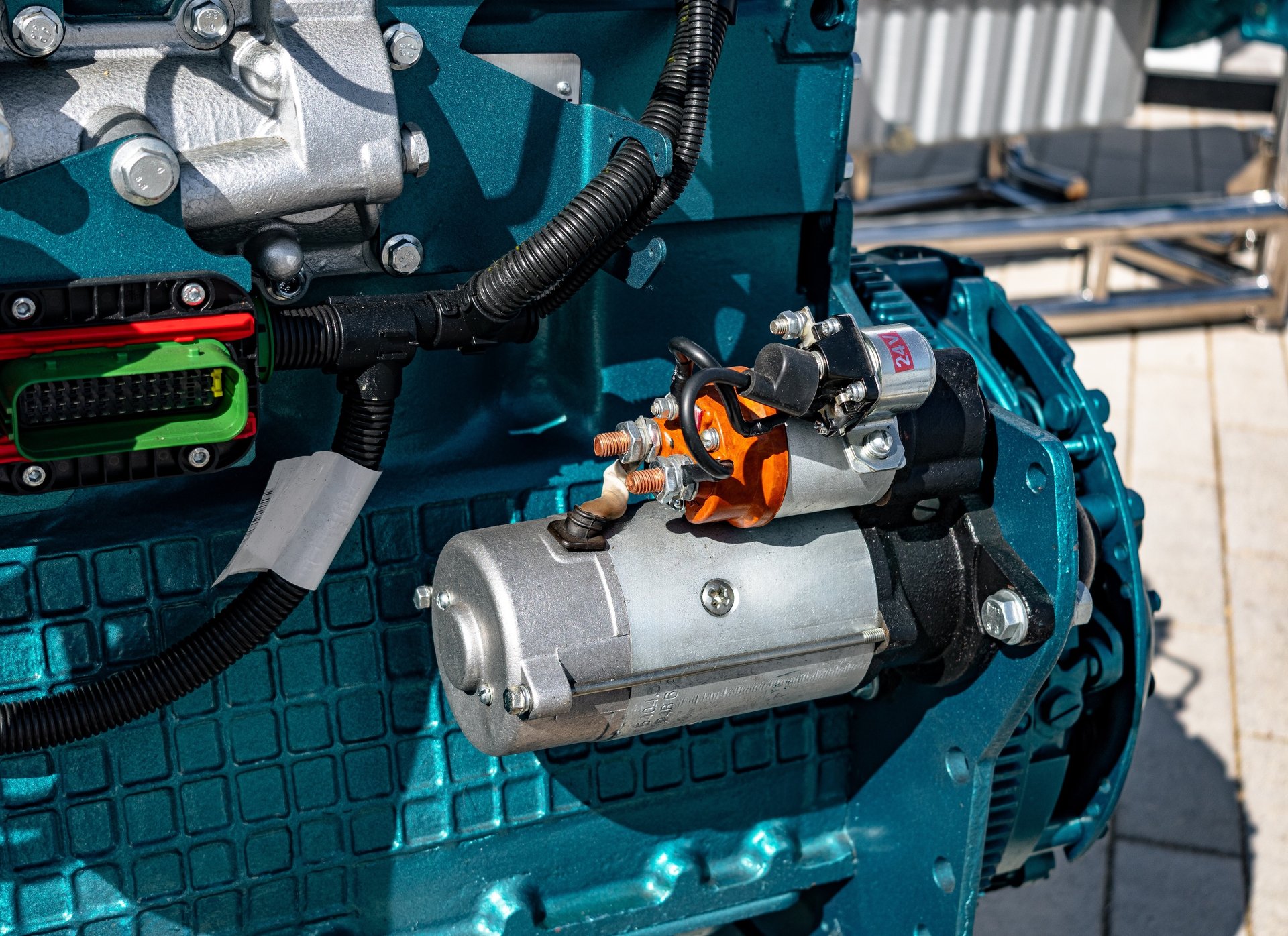
Three products get compared in the same spreadsheet and are worth naming separately, because they are not the same structure. A starter-mounted solenoid sits on the starter, pulls the drive into mesh and closes the main contacts. A remote starter solenoid does the switching from a fender or firewall position without the mechanical pull. A general continuous-duty contactor is built for a steady load and usually has no engagement function at all. Their electrical figures can be laid side by side, and sometimes that is useful, but a rating lifted from one describes the other less well than the shared shape suggests.
Two limits decide whether a part survives its application, and they are separate questions. The first is how long the coil may stay energized. A starter solenoid coil is wound for short energization, and its thermal design assumes the current stops in seconds. A continuous-duty coil holds at lower current indefinitely. The second is what the main contacts can do, which splits into making the circuit, carrying it, and breaking it, and a contact set can be comfortable on one of those and marginal on another.
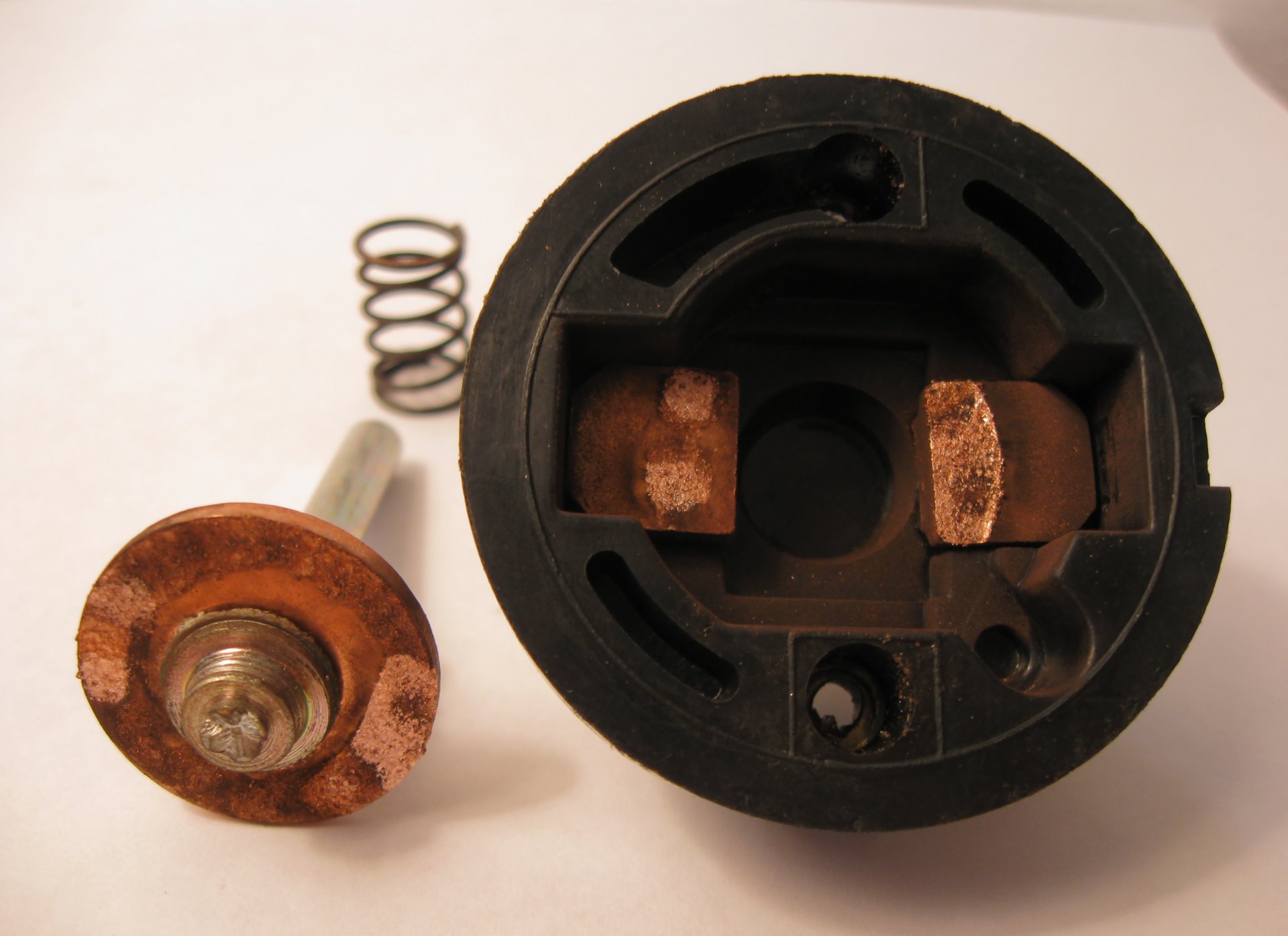
Crossing either limit has its own failure, and the two do not cause each other. Exceeding the permitted energization time heats the coil past what its insulation is built for, and the damage surfaces as a winding fault rather than at the contacts. Contacts that weld are a separate question, one that belongs to abnormal current, heavy arcing, repeated chatter or lost contact pressure. When they do weld the contacts closed, the starter can keep running after the engine catches, and that is usually how the solenoid ends up with the blame.
The second limit fails more quietly. A short-time carry rating says nothing about continuous carrying, and running past the continuous figure raises the temperature of the contacts, the terminals and the joints around them, which is a heat problem rather than a wear problem. Arc erosion belongs to the make and the break, and to chatter while the contacts are still moving apart. A circuit sitting closed and carrying current is not slowly arcing its way through the disc.
Whether a continuous-duty product can serve a cranking load is not decided by its category. It depends on its specific ratings against the current and duration involved, and on whether it performs the mechanical function the application needs, which for a starter-mounted unit includes pulling the drive into mesh. That is a question for the datasheet of the part in front of you, not for the label on the family.
Duty is rarely printed as a headline number, which is why it goes unchecked. It sits in a line carrying a duty percentage or an intermittent cranking note, or it is missing entirely. When it is missing, the current rating on the same sheet has no boundary, and a part rated at 100A continuous and a part rated at 100A peak end up in the same column of a comparison spreadsheet.
Four separate figures hide behind a single amperage on a sheet, and they measure different things.
The make or inrush rating is what the contacts can close into and withstand at the moment of closing, when the starter is stalled and current peaks. The short-time or cranking carry rating is what they hold for the seconds a crank lasts. The continuous carry rating is what they hold indefinitely without overheating. The break rating is what they can interrupt, and it is the one most often left off, because opening a high-current inductive circuit is the harder duty of the two.
An inrush figure is not a statement that the contacts will carry that current indefinitely without welding. It is a statement about closing into it. Reading one as a carry rating, or as a break rating, is where a comparison goes wrong before the prices are ever opened.
The conditions behind a rating decide whether two of them can be compared at all. The load type matters, because a resistive bench load and an inductive motor load stress contacts differently, and for an inductive load the figure only means something with the inductance or the load specified. The duration matters, because a rating quoted at ten seconds says nothing about a minute. The ambient temperature matters, because contact resistance and coil temperature both climb with it, which is why a rating measured on an open bench can be optimistic inside a hot engine bay. And the voltage across the contacts matters, because it is the voltage being broken that draws the arc, not the voltage that energized the coil.
That last point separates two figures a sheet prints close together. The 12V on the coil side describes what energizes the winding. It says nothing about what the main contacts are expected to break. A part built and tested to interrupt 100A at 12V has not thereby been shown to do the same at 24V, and a buyer comparing two 100A parts across a 12V and a 24V program is comparing numbers that were never on the same scale.
The test connection belongs in the same question. A rating measured through short heavy leads and a clamped joint is not necessarily the rating the same part delivers through a production harness with longer runs and smaller terminations.
None of this requires a laboratory argument. It requires one question in writing. Ask what the 100A was measured against, for how long, at what voltage, and through what connection. A supplier who cannot answer has published a marketing figure, and a supplier who answers with a test condition has published a specification.
Three posts and four posts describe a shape, not a function, and the functions behind the shape vary by design family.
One common three-post arrangement grounds the coil through the mounting base, so the housing must sit on a clean conductive surface for the part to work at all. A four-post unit of the same size may use the extra post for an isolated coil return, which allows mounting on a painted or non-conductive surface. On other families the additional post feeds the ignition circuit during cranking, a function historically associated with older or remotely mounted solenoids.
Two parts with the same post count can therefore be wired differently, and two parts with different post counts can serve the same vehicle. What settles it is the housing marking, the wiring diagram for that application, and whether the coil grounds through the base. The count on its own settles nothing, and matching a familiar-looking body is how a return gets created.
The same discipline applies one step upstream. A solenoid does not sit alone in the starting circuit, and the component feeding its control terminal is a separate part with its own failure modes, which is why the control circuit is worth separating from the high-current path before blaming either.
A number like 100,000 cycles reads as durability and often means nothing at all.
Mechanical life counts actuations with no current flowing through the contacts. Electrical life counts switching cycles at a stated load, and the two figures differ by a wide margin on the very same part. A sheet printing one number without saying which is printing a figure you cannot use.
Where electrical life is stated, three details decide its value. The load it was tested at, since contact erosion at a rated current is nothing like erosion at a fraction of it. The on and off times, since a cycle defined as one second on and nine seconds off gives the contacts far more cooling than one defined as five seconds on and five off. And the ambient temperature, for the same reason it matters in the current rating.
A supplier who publishes electrical life at a defined load, with the cycle timing attached, has published a test result rather than a claim. That is more than most sheets offer, and it still describes only the part under that test. It does not tell you the design suppresses arcs well. It tells you the contacts survived a stated number of cycles under stated conditions, which is the only form in which that information is worth anything. A large round number without those conditions is not a shortened version of the same thing.
Two solenoids built to the same electrical rating can run different contact alloys, and the difference is usually left off the sheet entirely.
The temptation is to rank the alloys, with copper and brass at the bottom and a silver alloy at the top. That ranking does not survive contact with a test bench. Contact performance comes from the alloy, the contact pressure behind it, the contact area, the load being switched, and the arc control around it, all at once. A silver-faced contact with weak pressure and no arc control can erode faster than a plainer contact in a well-designed chamber carrying a lighter load.
What a material name tells you is which problems the designer was working on. What it does not tell you is life, and a declaration on a sheet is not a verification of anything. Two parts are comparable on their results at the same test condition, not on the grade of their alloy.
The same silence covers terminal plating and seal material. Those two decide how the part behaves in a coastal market or a road-salt winter, and neither shows up in a bench test. A supplier who can name the alloy, the plating, and the seal compound has usually thought about the environments those choices address. One who describes all three as high quality has not answered the question.
The specification comparison problem is solved before the quotes arrive, not after.
Ask for every electrical figure with its test condition attached, and treat a bare number as incomplete rather than as favorable. Ask for a test report rather than a compliance claim, because meets OE specification is a statement about intent and a report is a statement about a part. Ask how changes to the design or the sub-supplier are communicated, since a silent revision is the classic way a validated reference drifts.
Then pin the reference down physically. Keep an approved sample with the dimensional report, the material specification and the test record next to it, and run sample inspection against that sample rather than against the catalogue photograph. The paperwork and the part have to agree, and only one of them arrives in a box.
None of this makes a cheap part expensive or an expensive part trustworthy. It makes the quotes comparable, which is the only thing a spec sheet was ever for.
Only after the two sheets agree on more than those two figures. Check the duty, the pull-in, holding and release figures with their definitions, whether the coil grounds through the base, and the test conditions behind the contact rating. Where all of that matches and the mounting and stroke dimensions fit the starter, the swap is reasonable. Where the sheets are silent on those points, the match is a coincidence of labels.
No. A rating is only meaningful against the load it will actually switch, and an oversized contact set does not compensate for a coil with little margin between its holding requirement and the supply, or for a seal that lets moisture in. Oversizing also changes nothing about duty, so a high-current intermittent part still cannot be energized continuously.
Not reliably. Common conventions exist for battery, motor, and switch terminals, and some families add a marking for a fourth function, but the same letter or position does not guarantee the same internal connection across manufacturers. The wiring diagram for the application, plus a check of whether the coil is base-grounded or isolated, is what actually confirms the part.
Often it does, and rarely in the wording a buyer reads first. Many supplier warranties exclude damage from use outside the specified duty, so an intermittent part energized continuously can be declined even when the part itself was sound. Read the application clause before the coverage period. It is also worth asking who decides whether a failure was duty-related, since that answer usually determines how the claim ends.
No, and building one for a one-off repair is a poor use of the afternoon. A single replacement can be sourced from a verified catalogue interchange, the specific application, and confirmation of the interfaces that actually matter: mounting pattern, stroke, terminal arrangement, and whether the coil grounds through the base. That is a narrower check than a full specification review, and it is not the same thing as matching an old number and a similar-looking body, which is where single repairs go wrong. The economics change when the purchase repeats, because a reference that was never specified cannot be re-sourced consistently, and the second batch is where the differences surface.